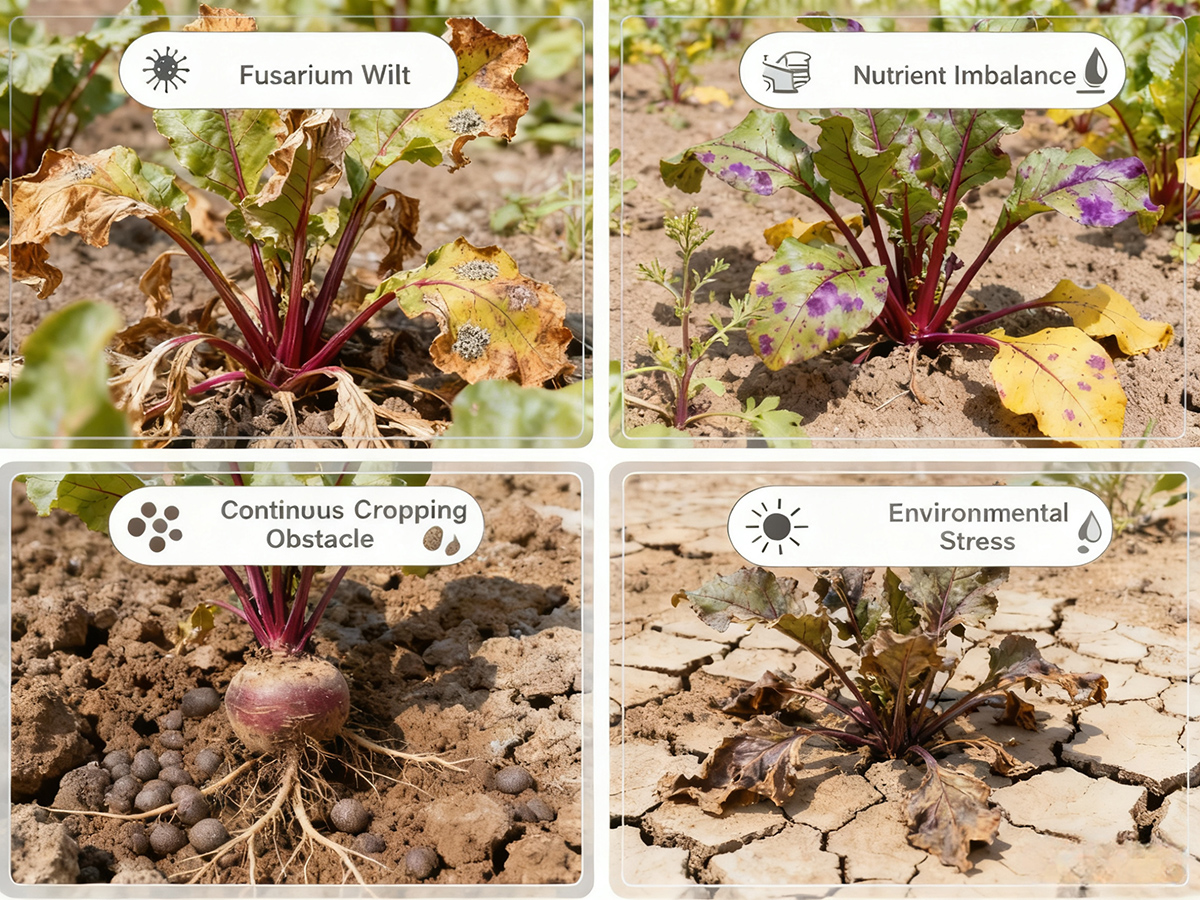
Performance of production reduction: the mortality rate of plants in the diseased plots can reach more than 35% (monitoring data from the French Agricultural Research Institute INRAE in 2024), the root weight of surviving plants is reduced by 30-40%, and the root rot rate increases and the commodity rate decreases.
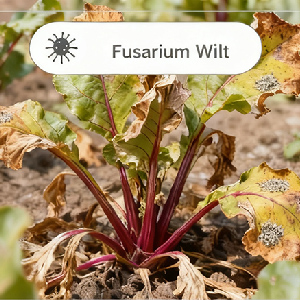
Outbreak of wilt disease
The number of nitrogen-fixing bacteria has decreased, and the effective soil potassium content of plots with continuous cropping for more than 5 years is 25-30% lower than that of rotating fields; the distribution depth of the beetroot system has been reduced from 60cm to 30cm, and the range of water absorption and fertilizer absorption has been reduced.
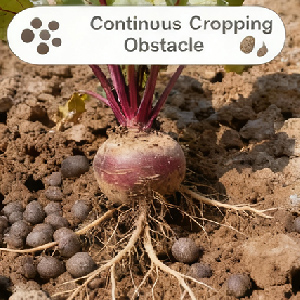
Obstacles to continuous cropping
Production reduction data: 70% of sugar beet plots in Europe are deficient in boron and calcium to varying degrees, and the yield per acre decreases for every 10% increase in the rate of deformed roots.Inducing factors: When the soil pH is >7.5, boron and calcium are easily fixed; uneven drip irrigation system leads to insufficient local nutrient supply.

Nutritional imbalance
(July-August) If there is continuous drought, the transpiration of leaves is stronger than the absorption of water by the roots, which will cause the roots to stop growing and the deficiency of nutrients will be more obvious; stagnant water for more than 48 hours in the rainy season will cause root rot, and the spread of pathogenic bacteria will be faster.

Environmental stress
Trelfey's corresponding solution: anti-stubble-resistant microbial agent (containing Bacillus subtilis) + potassium humate particles, which can reduce the incidence rate from 42% to 7% (refer to the case of a 500-acre base in northern France).

Outbreak of wilt disease
Principle: Caused by the infection of Fusarium acanthosporum, the pathogen invades the beetroot system and clogs the vascular bundle, causing nutrient transportation to be interrupted, and the plants gradually wither.
Trelfey's corresponding solution: high-quality and high-content potassium humate particles can improve the soil pellet structure, quickly supplement organic matter + anti-stubble microbial agents, and one growth cycle can increase soil organic matter by 1.2% and root vitality by 50%.
Obstacles to continuous cropping
The flora is unbalanced, nutrients are exhausted, and the soil is compacted: the number of beneficial bacteria is reduced, and the proportion of pathogenic bacteria is increased; the soil organic matter is reduced; and the permeability of the tillage layer decreases.
Trelfey corresponding solution: amino acid + calcium and magnesium + fish protein liquid fertilizer (chelated nutrition, absorption rate increased by 30%), combined with MKP drip irrigation, the deformity rate can be reduced to less than 5%.
Nutritional imbalance
Core deficiency problem: Boron deficiency and calcium deficiency: During the formation of beet roots, the center of the roots will be lignified and hollow, which will affect the development of the cell wall of the roots and cause root deformities.
Trelfey's corresponding plan: apply potassium humate before drought (improve water retention capacity), combined with amino acid + trace element liquid fertilizer foliar spraying (enhance leaf drought resistance); irrigate the roots with microbial agents in time after waterlogging to repair.
Environmental stress
Drought and waterlogging: If there is no effective rainfall for 15 consecutive days during the root enlargement period of sugar beet, the weight of the single root of the beet will be reduced by 40%; stagnant water in the rainy season will cause the root system to be hypoxic and rot, causing root rot.