
A maize fertilizer program in West Africa follows three rules. Place all phosphorus and potassium at planting. Split nitrogen across two or three applications. Match the grade to the growth stage. Follow these rules and a moderate rate beats a heavy single dose. Skip them and much of your nitrogen leaves the field early.
Why a Maize Fertilizer Program Fails on West African Soils
Most maize in West Africa grows on sandy soils. These soils hold less than 1% organic matter. They store few nutrients and little water. The clay and organic fractions are low. Cation exchange capacity therefore stays low as well. As a result, applied potassium and ammonium can leach below the roots after one heavy rain.
However, phosphorus behaves differently. Savanna soils are weathered and often acidic. Free iron and aluminium fix phosphate into forms the plant cannot absorb. Much of any broadcast phosphate therefore never reaches the roots. Placement matters as much as rate.
The yield gap shows the problem. Smallholders in Nigeria, Ghana and Mali harvest 1.5 to 2.5 tonnes per hectare. Improved varieties can reach 5 to 8 tonnes under irrigation. Genetics rarely limit the crop. Water and nutrition do.
Moreover, zinc is a second constraint here. Sandy soils with high pH and low organic matter often produce zinc-deficient maize. The symptom is easy to mistake for disease. Breeding has already improved the genetics, and IITA’s maize programme has released stress-tolerant varieties for these zones. A well-timed maize fertilizer program now closes part of the remaining gap.
What Your Yield Target Actually Removes from the Soil
Set rates from the crop you intend to harvest. Do not set them from last season. One tonne of maize grain removes about 15 to 20 kg of nitrogen. It also removes 8 to 10 kg of P₂O₅ and 15 to 20 kg of K₂O. The exact figure depends on the hybrid. It also depends on whether you remove the stover.
Work backwards from that removal figure. Then allow for the share of nutrient the crop cannot recover. The table below gives indicative planning rates. Treat them as a starting point for a soil test. They are not a replacement for one.
| Target yield (t/ha) | N (kg/ha) | P₂O₅ (kg/ha) | K₂O (kg/ha) |
|---|---|---|---|
| 2.5 (rain-fed, low input) | 60–80 | 30–40 | 40–50 |
| 4.0 (rain-fed, improved) | 100–120 | 45–60 | 60–80 |
| 6.0+ (irrigated, dry season) | 150–180 | 60–80 | 90–120 |
In addition, two details decide whether you hit these numbers. First, test a representative sample of your soil. A laboratory result beats any table. Second, raise organic matter as well as mineral fertilizer. Nutrients held on exchange sites leach far less than nutrients in solution.
The Three-Split Maize Fertilizer Program: Timing Beats Rate
Nitrogen is the nutrient most often wasted. The reason is simple arithmetic. Maize takes up more than half of its total nitrogen between tasseling and early grain fill. Apply everything at planting and that nitrogen must survive eight to ten weeks of rain. Much of it will not.
So split the applications. A practical maize fertilizer program for the region looks like this:
| Application | Timing | Typical product | Nitrogen share |
|---|---|---|---|
| Basal at planting | At sowing, 5 cm beside the seed | NPK 15-15-15 or 20-10-10 with zinc | One third |
| First top-dress | 3–4 weeks after sowing, knee-high | Urea (46-0-0) or high-N water-soluble NPK | One third |
| Second top-dress | 6–7 weeks after sowing, pre-tasseling | Urea or a 30-10-10 water-soluble grade | One third |
Then phosphorus and potassium go down at planting. Both nutrients move slowly through soil. They need to sit near the developing roots. You can drop the second top-dress on short-season varieties. You can also drop it when the rains end early. In that case, move the share into the first top-dress.
Notably, placement repays attention. Band the basal fertilizer 5 cm to the side of the seed. Direct contact with the seed burns germinating roots. Broadcast urea onto moist soil. Never broadcast it onto wet leaves in full sun.
Matching Fertilizer Grades to Growth Stages
Grade matters less than timing. The right grade still makes timing easier. At establishment, a balanced grade such as 20-10-10 supplies phosphorus and potassium. It also adds a modest nitrogen starter. For top-dressing, urea is the cheapest nitrogen source per kilogram. Water-soluble NPK fertilizer becomes the better choice once you inject through a drip line.
During vegetative growth, a nitrogen-forward grade such as 30-10-10 suits fertigation. It dissolves cleanly and leaves no residue in the lines. Once the crop reaches silking, priority shifts to potassium and phosphorus. A low-nitrogen grade such as 0-52-34 or 10-5-45 then does more for grain weight. Our guide to how NPK ratios work explains what each position controls.
Therefore, choose chloride-free grades for fertigation. Maize tolerates chloride well. Repeated chloride loading still raises salinity in a closed irrigation system.
Reading Nutrient Deficiency Symptoms Before Yield Is Lost
A visible deficiency has already cut yield. Scouting pays because you correct early. It is not diagnosis for its own sake.
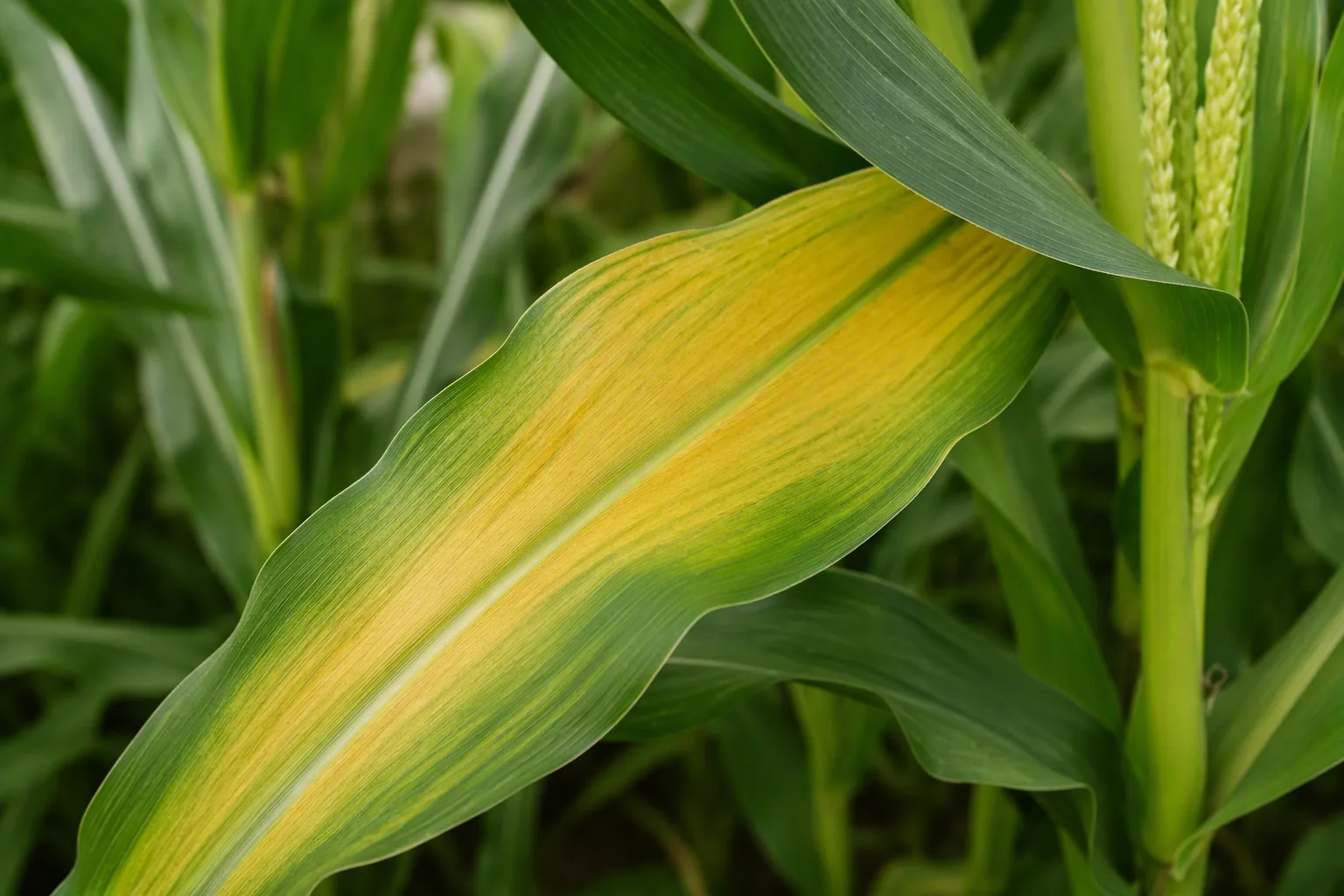
Nitrogen deficiency starts on the oldest leaves. Look for V-shaped yellowing from the leaf tip down the midrib. Nitrogen is mobile, so the plant moves it to the growing point. The lower leaves strip first. Phosphorus deficiency appears on young plants instead. The leaf margins turn purple or red. Cold, wet soil causes it more often than low soil phosphate. Potassium deficiency yellows the margins of older leaves. Those margins then brown. Stalks weaken and tips fill poorly.
Zinc deficiency looks different and is worth memorising. Young leaves show pale bands on both sides of the midrib. Internodes shorten, so the plant looks compressed. Sulphur deficiency also pales young leaves. Unlike nitrogen, it affects the whole leaf evenly.
Finally, record what you see. Note the leaf position and the growth stage. Then compare it against your soil test. A pattern across a whole block points to soil chemistry. A pattern in patches points to compaction, drainage or uneven application.
Fertigation for a Dry-Season Maize Fertilizer Program
Dry-season maize under irrigation is now a reliable income crop. It performs well in northern Nigeria, Niger and the Senegal River valley. It also suits fertigation far better than rain-fed maize does. You control the water and the nutrient concentration. Consequently, the crop never waits for rain. Dry-season grain also earns a price premium when it reaches the market out of season.
Inject a water-soluble NPK grade at each irrigation cycle. Keep the concentration stable instead of spiking it. Our walkthrough of fertigation injection basics covers the equipment side. The discipline of daily EC and pH checks keeps a program on track all season.
Nevertheless, two habits prevent most failures. First, flush the drip lines at the end of each cycle. Undissolved salts otherwise build up at emitters and cut flow unevenly across the field. Second, calibrate the injector at the start of the season, because a 10% dosing error compounds across every irrigation for four months. If you fertigate a large block, also install an inline filter and check it every week.
Fixing Soil Acidity and Organic Matter at the Same Time
About a third of maize soils in the region sit below pH 5.5. At that pH, aluminium toxicity restricts root growth. Phosphorus availability also collapses. Liming with agricultural lime or dolomite raises pH towards 5.8 to 6.5. That is the range maize prefers. Lime works over months, not weeks. Apply it well before planting.
Instead, do not lime and fertilize in the same band on the same day. Lime raises pH sharply around the granules. That shift can convert ammonium to ammonia gas. Your nitrogen then escapes to the air. Apply lime, incorporate it, then wait before banding fertilizer.
In contrast, organic inputs solve the other half of the problem. Bio-organic fertilizer or a humic-based product raises exchange capacity on sandy soils. Your mineral fertilizer then stays available for longer. On the sandiest fields this combination changes response more than a higher NPK rate. Soil testing and balanced use follow the principles in FAO’s soil fertility guidance.
Frequently Asked Questions
What is the best NPK for maize in West Africa?
There is no single best grade. The answer depends on your soil test and your growth stage. A balanced grade such as 20-10-10 or 15-15-15 works at planting. Follow it with urea or a nitrogen-forward water-soluble grade for top-dressing. That covers most rain-fed maize. Irrigated maize responds well to fertigation instead. Shift the grades from nitrogen-forward in vegetative growth to potassium-forward in grain fill.
How many times should I split nitrogen on maize?
Two splits are the practical minimum. One goes at planting and one at knee-high. A third split adds a pre-tasseling application. Any maize fertilizer program with three splits gives a more reliable return when rainfall continues into the season. Two splits are safer on short-season varieties and when the rains end early.
Can I use water-soluble fertilizer on maize?
Yes. On irrigated maize it is usually the best option. Water-soluble grades dissolve completely. You can inject them through drip or sprinkler systems without blocking emitters. You also deliver small nitrogen doses exactly when the crop needs them. On rain-fed maize, granular urea stays cheaper for top-dressing unless you already irrigate.
Why are my maize leaves turning purple?
Purple or reddish leaf margins on young maize usually indicate phosphorus deficiency. The cause is often cold, wet soil. Cold soil slows root growth and phosphorus uptake. It is not always a shortage of phosphate in the soil itself. Check soil temperature, drainage and compaction first. Where phosphorus is genuinely low, band the basal dose beside the seed for the fastest response.
Planning a Maize Fertilizer Program Around the Season
Build the plan backwards from the harvest date. First decide the yield target. Then take a soil sample. Then set the total nutrient budget. Divide it into the basal application and the top-dressings above. The whole program depends on timing, so write the dates into a calendar before you order.
Also, order fertilizer early. Prices rise once the rains begin. Confirm the grade, packaging and delivery terms against your specification. A substituted grade changes your split ratios. Store bags dry and off the floor, because caked urea cannot be spread evenly. Explore our foliar and fertigation-grade fertilizer range to match a grade to each stage.
Suggested metadata for the WordPress editor:
- Focus keyphrase: maize fertilizer program
- Slug: maize-fertilizer-program-west-africa
- Category: agricultural-planting-knowledge
- Tags: crop-programs, plant-nutrition, soil-management
- Excerpt: A practical maize fertilizer program for West African soils: NPK rates by growth stage, split application timing and key deficiency symptoms.
- Yoast meta description: A practical maize fertilizer program for West African soils: NPK rates by growth stage, split application timing and key deficiency symptoms.